
Visceral Adipose Tissue (VAT)
Visceral adipose tissue is the deep fat in the abdomen that encases the organs and is associated with multiple negative health outcomes

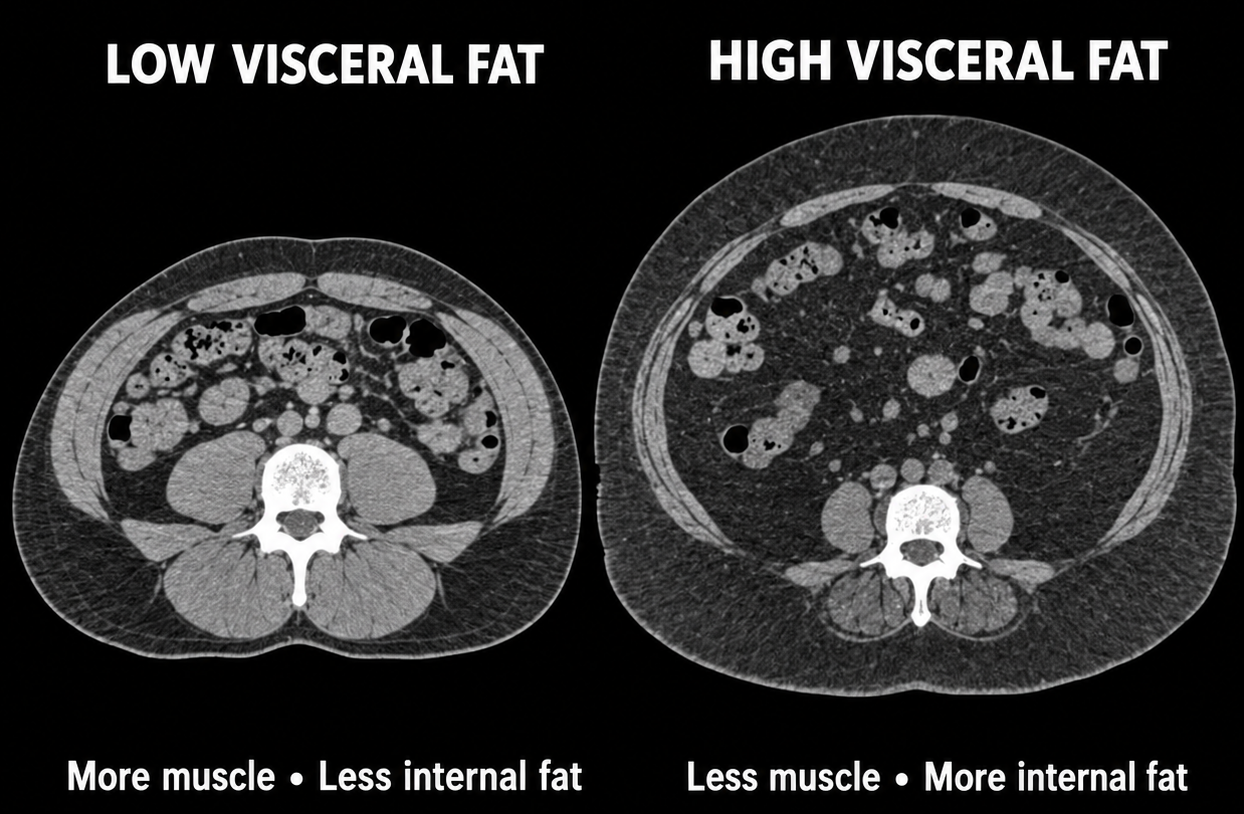
Visceral Adipose Tissue (VAT)
Subcutaneous fat is the adipose (fat) tissue just under the skin that can be pinched and felt. Visceral adipose tissue (VAT) is belly fat deeper in the abdominal cavity that wraps around the internal organs. VAT is independently associated with cardiovascular disease (CVD), type 2 diabetes (T2D), Metabolic Syndrome, and multiple cancers. The association for these conditions is stronger for VAT than it is for subcutaneous fat, body mass index (BMI), or total fat mass and evidence increasingly supports VAT being a direct cause of these conditions. VAT is metabolically active tissue that creates a pro-inflammatory, insulin resistant state by releasing free fatty acids, dysregulated adipokines, and inflammatory cytokines.(1,2,3)
Cardiovascular Disease
There is a strong, dose-dependent association between VAT and CVD. In the Mutli-Ethnic Study of Atherosclerosis, 1,910 individuals with CT measured VAT showed that VAT, but not subcutaneous fat, was significantly associated with CVD risk regardless of age, sex, race, or ethnicity.(4) In the Framingham cohorts, each standard deviation increase in CT-quantified VAT was associated with about a 40% higher risk of subsequent CVD.(5) The American Heart Association (AHA) scientific statement concludes that at any BMI, individuals with excess VAT represent the subgroup at the highest CVD risk, and that VAT “serves as a clear health hazard”.(1)
Type 2 Diabetes and Metabolic Syndrome
Increased VAT is associated with increased risk of T2D, insulin resistance, and atherogenic dyslipidemia regardless of BMI (7,9), an association not seen with gluteofemoral (hip and thigh) fat or subcutaneous fat, demonstrating that fat distribution more than total fat is the main driver of risk.(10) Studies quantifying VAT using DXA (7,8) suggest VAT ≥ 100 cm2 is predictive of Metabolic Syndrome, T2D, and insulin resistance.(8) Waist circumference and waist-to-height ratio were similarly predictive as DXA (8) and does not require specialized equipment or radiation exposure, making it a good proxy for assessing VAT and associated risks.
Cancer
Increased VAT is associated with increased risk of getting, and dying from, obesity-related cancers. (11,12,13) Each additional 100 cm2 of VAT corresponds to a 32% higher risk of obesity-related cancers, with a nearly two-fold increase in the highest quartile. (11) Mendelian randomization supports a causal effect of VAT with pancreatic cancer and lung squamous-cell carcinoma. (14) An integrative review concluded that VAT increases the risk of colorectal, pancreatic, and gastro-esophageal cancers, with sex- and menopause-specific effects for breast, endometrial, and renal cancers. (15)
Mechanism
The underlying driver of disease risk with regards to VAT is through chronic low-grade inflammation (“metainflammation”) with macrophage infiltration and elevated inflammatory markers (TNF-ɑ, IL-6), reduced adiponectin and altered adipokine secretion, increased free-fatty-acids promoting insulin resistance and fat deposition, insulin resistance resulting in hyperinsulinemia and IGF-1 axis stimulation (relevant to cancer), and endothelial dysfunction/oxidized LDL formation promoting atherosclerosis (relevant to heart disease). (2,3,7,9,16)
Interventions to Reduce VAT
Exercise, calorie restriction, GLP-1 receptor agonists, SGLT2 inhibitors, and bariatric surgery all reduce VAT and translate to improved cardiometabolic outcomes through improved insulin sensitivity, glycemic control, lipids, and inflammatory markers. (17,18,19)
Exercise
Aerobic exercise is the most consistently effective lifestyle modality for VAT reduction. (18,20) Aerobic exercise reduces VAT even without weight loss, and relative to the weight lost, exercise removes more VAT than diet or pharmacotherapy. (1,19) The AHA notes that aerobic interventions are the most beneficial and meeting 150 min/week of activity may be sufficient to reduce VAT (1) but aerobic exercise shows a dose-dependent effect, where more aerobic exercise translates to greater loss. (18,20)
Caloric Restriction
Hypocaloric diets are effective at reducing VAT (21) as well as improving glucose tolerance and insulin sensitivity. (22) Combining exercise with a hypocaloric diet is generally recommended for the most sustainable cardiometabolic benefit. (19)
GLP-1 receptor agonists (GLP-1 RAs)
GLP-1 RAs preferentially reduce VAT and also improve glycemic and cardiovascular risk. A meta-analysis of 10 randomized controlled trials (RCTs) in T2D found GLP-1 RAs preferentially reduced VAT (~11.2%) versus subcutaneous fat (~8.3%) (23) while also reducing liver fat content, (24) improving liver enzymes (24) and reducing major adverse cardiac events (MACE). (9,25)
SGLT2 inhibitors
SGLT2 inhibitors reduce VAT, epicardial (around the heart), and intrahepatic (within the liver) fat and are superior to GLP-1 RAs in reducing epicardial adipose tissue (26) making them the drug of choice in people with T2D and heart or kidney disease. (9)
Bariatric Surgery
Surgery produces the largest sustained reductions in VAT and ectopic fat. (19,27) This is accompanied by cardiometabolic improvements in markers of insulin sensitivity (HOMA-IR, HbA1c), lipid profile (HDL), and inflammatory markers ( IL-6, CRP). (28)
Conclusion
Excess VAT is associated with several disease outcomes and is a health hazard. Pharmacotherapy and surgery reduce VAT more than exercise but exercise removes the most VAT relative to total weight loss. Combining a hypocaloric diet and exercise with pharmacotherapy or surgery yields the greatest and most long-lasting cardiometabolic benefit.
Disclaimer: this article is for educational purposes only, is not medical advice, and does not create a patient-physician relationship.
References:
1. Powell-Wiley TM et al. Obesity and Cardiovascular Disease: A Scientific Statement From the American Heart Association. Circulation. 2021.
2. De Oliveira-Gomes D et al. 2026. Cardio-Obesity and Therapeutic Advances: Intersections Between Excess Adiposity, Cardiovascular Risk, and [ ]. Current Atherosclerosis Reports.
3. Stefan N. 2020. Causes, Consequences, and Treatment of Metabolically Unhealthy Fat Distribution. The Lancet. Diabetes and Endocrinology.
4. Mongraw-Chaffin M et al. CT-Derive Body Fat Distribution and Incident Cardiovascular Disease: The Multi-Ethnic Study of Atherosclerosis. The Journal of Clinical Endocrinology and Metabolism. 2017
5. Wilkens LR et al. Prediction of Future Visceral Adiposity and Application to Cancer Research: The Multiethnic Cohort Study. PloS One. 2023
6. Yi D, Tang X, Xing Z. Visceral and Subcutaneous Adiposity and Cardiovascular Disease: Unraveling Associations and Prognostic Value. Diabetes, Obesity & Metabolism. 2024.
7. Gupta P et al. 2019. The Association Between Body Composition using Dual energy X-ray Absorptiometry and Type-2 Diabetes: A [...]. Scientific Reports
8. Potter AW, Friedl KE. Cross-Sectional Analysis of Visceral Adipose Tissue Associations with Obesity-Related Disease. 2025. The American Journal of Clinical Nutrition.
9. Despres JP, Carpentier AC, Tchernof A, Neeland IJ, Poirer P. 2021. Management of Obesity in Cardiovascular Practice: JACC Focus Seminar.
10. Agrawal S, Klarqvist MDR, Diamant N, et al. 2023. BMI-adjusted adipose tissue volumes exhibit depot-specific and divergent associations with cardiometabolic [...].
11. Blew RM et al. 2026. DXA-Derived Abdominal Adiposity and Obesity-Related Cancer Risk Among Postmenopausal Women in the Women’s [..]. Obesity.
12. Katzmarzyk PT et al. 2022. Association of Abdominal Visceral Adiposity and Total Fat Mass with Cancer Incidence and Mortality in White and Black…Cancer Epidemiology, Biomarkers & Prevention: A Publication of the American Association for Cancer Research, Cosponsored by the American Society of Preventative Oncology.
13. Lu Y et al. A Validated Estimate of Visceral Adipose Tissue Volume in Relation to Cancer Risk. Journal of the National Cancer Institute. 2024
14. Lu Y et al. Assessment of Causal Effects of Visceral Adipose Tissue on Risk of Cancers: A Mendelian Randomization…International Journal of Epidemiology. 2022
15. Silveira EA. 2021. Visceral Obesity and Incident Cancer and Cardiovascular Disease: An Integrative Review of the Epidemiological…Obesity Reviews: An Official Journal of the International Association for the Study of Obesity.
16. Doyle SL, Donohoe CL, Lysaght J, Reynolds JV. Visceral Obesity, Metabolic Syndrome, Insulin Resistance and Cancer. The Proceedings of the Nutrition Society. 2012.
17. Klein H et al. Lifestyle-Induced Visceral Fat Loss as a Key Target for Durable Cardiometabolic Health: MRI-Assessed 5- and 10-year [..] Circulation. 2026
18. Recchia F et al. Dose-Response Effects of Exercise and Caloric Restriction of Visceral Adiposity in Overweight and Obese Adults: A [..] British Journal of Sports Medicine. 2023
19. Valenzuela PL, et al. Obesity and the risk of cardiometabolic diseases. Nature Reviews. Cardiology. 2023.
20. Maeyens LT, Nelson JF, Zhao S. Visceral adiposity, metabolic health, and aging. Nature Aging. 2026.
21, Neeland IJ, et al. 2019. Visceral and Ectopic Fat, Atherosclerosis, and Cardiometabolic Disease: A Position Statement. The Lancet. Diabetes & Endocrinology.
22. Weiss EP, Holloszy JO. 2007. Improvements in Body Composition, Glucose Tolerance, and Insulin Action Induced by Increasing Energy Expenditure… The Journal of Nutrition.
23. Liu F, et al. 2022. The effects of glucagon-like peptide-1 receptor agonists on adipose tissue in patients with type 2 diabetes: A meta-... PloS One.
24. Liao C, Liang X, Zhang X, Li Y. The effects of GLP-1 receptor agonists on visceral fat and liver ectopic fat in an adult population with or without diabetes… PloS One. 2023
25. FDA Orange Book. 2026
26. Bao Y, Hu Y, Shi M, Zhao Z. SGLT2 inhibitors reduce epicardial adipose tissue more than GLP-1 agonists or exercise interventions in patients with… Diabetes, Obesity, & Metabolism. 2025.
27. Guldan M, et al. Targeting visceral and ectopic adiposity: Pharmacological and surgical interventions beyond global weight loss. Diabetes, Obesity, & Metabolism. 2025
28. Metwally E, et al. 2026. Adiposome Lipidomic Shifts Following Bariatric Surgery in Association With Weight Loss and Cardiometabolic Benefit. The Journal of Clinical Endocrinology and Metabolism.