
Cardiorespiratory Fitness
Building and Preserving Physiological Reserve

Cardiorespiratory Fitness: Building and Preserving Physiological Reserve
Cardiorespiratory fitness describes your body's ability to take oxygen from the environment, transport it through the lungs, heart, blood, and circulation, and ultimately use that oxygen within working muscle. At the upper limit of this system is VO₂max: the greatest amount of oxygen your body can use during intense exercise. VO₂max is often thought of as an athletic performance metric. It certainly matters for endurance performance, but its importance extends well beyond sport.
Cardiorespiratory fitness represents something more fundamental: physiological reserve. It is the difference between what your body is capable of doing and what everyday life requires of it. That reserve influences whether climbing stairs feels routine or exhausting, whether you can hike on vacation, carry luggage through an airport, play with children or grandchildren, and maintain independence later in life. It may also matter when life temporarily demands more from you during illness, surgery, injury, or prolonged inactivity.
The goal, therefore, is not simply to achieve an impressive VO₂max. It is to maintain enough capacity that the physical demands of life remain comfortably below the limits of what your body can do.
What is cardiorespiratory fitness?
Sustained physical activity requires multiple physiological systems to work together. Your lungs move oxygen into the bloodstream. Your heart pumps oxygenated blood forward. Blood vessels distribute it to active tissues. Hemoglobin carries oxygen. Skeletal muscle extracts that oxygen and uses it within mitochondria to generate energy. Therefore, cardiorespiratory fitness does not measure the performance of a single organ. It reflects the integrated capacity of the entire oxygen transport and utilization system.¹
As exercise intensity increases, oxygen consumption rises to meet increasing energy demand. Eventually, an individual reaches either a physiological maximum or the highest oxygen consumption they can achieve before exercise must stop. That value is reported as VO₂max or, when strict criteria for a true physiological maximum are not demonstrated, VO₂peak.
VO₂ is commonly expressed relative to body weight in milliliters of oxygen per kilogram per minute (mL/kg/min). It can also be expressed as absolute oxygen consumption in liters per minute (L/min). Both provide useful but somewhat different information and their interpretation becomes particularly relevant in context. For example, relative VO2 max could increase if body weight decreased even if the absolute VO2 max remained the same.
How do we measure cardiorespiratory fitness?
Cardiorespiratory fitness can be estimated in several ways, including exercise tests that use treadmill speed, cycling workload, heart rate, or exercise duration to predict aerobic capacity. The most direct assessment is cardiopulmonary exercise testing, or CPET, in which respiratory gases are measured while exercise intensity progressively increases.¹ Rather than estimating oxygen consumption from an external workload, CPET measures how much oxygen the individual is actually consuming and how much carbon dioxide is being produced.
VO₂max or VO₂peak is the most familiar result, but it is only one part of the information generated. CPET can also help characterize ventilatory thresholds, heart-rate response and recovery, breathing patterns, ventilatory efficiency, exercise tolerance, and the relationship between increasing workload and the body's cardiovascular, pulmonary, and metabolic responses.
This distinction matters because physical activity and physical fitness are related, but they are not the same thing. Physical activity describes behavior, i.e. how much someone moves or exercises. Cardiorespiratory fitness describes the physiological capacity that results from the interaction of exercise, genetics, age, body composition, health conditions, medications, and other factors. Two people who report similar exercise habits can therefore have very different aerobic capacities.
Why does cardiorespiratory fitness matter?
Cardiorespiratory fitness has one of the strongest and most consistent relationships with long-term health outcomes among measurable physiological characteristics.¹ A 2022 meta-analysis included 37 cohort studies, more than 2.25 million participants, and 108,613 deaths. Individuals in the highest third of objectively measured cardiorespiratory fitness had approximately a 45% lower adjusted risk of all-cause mortality than those in the lowest third. Each additional 1 MET of fitness (a VO2 of approximately 3.5 mL/kg/min) was associated with about an 11% lower relative risk of death.² A broader 2024 overview incorporated 199 cohort studies representing more than 20.9 million observations. Higher cardiorespiratory fitness was consistently associated with lower all-cause and cardiovascular mortality and lower incidence of several chronic diseases.³ This relationship is strong enough that the American Heart Association has argued that cardiorespiratory fitness should be considered a clinical “vital sign.”¹
Aerobic capacity declines with age
Cardiorespiratory fitness generally decreases throughout adulthood. But the decline is not constant and the rate of decline tends to increase as we age. One of the most useful longitudinal examinations comes from the Baltimore Longitudinal Study of Aging. Fleg and colleagues followed 810 healthy adults (375 women and 435 men, ages 21 to 87) with serial maximal exercise testing over a median of 7.9 years.⁴ They found that VO₂peak declined in every adult age decade studied, but the rate of decline accelerated markedly with advancing age. Decline was approximately 3–6% per decade during the 20s and 30s, while losses exceeded 20% per decade in adults in their 70s and beyond. The longitudinal decline also became greater in men than women beginning in the 40s.⁴

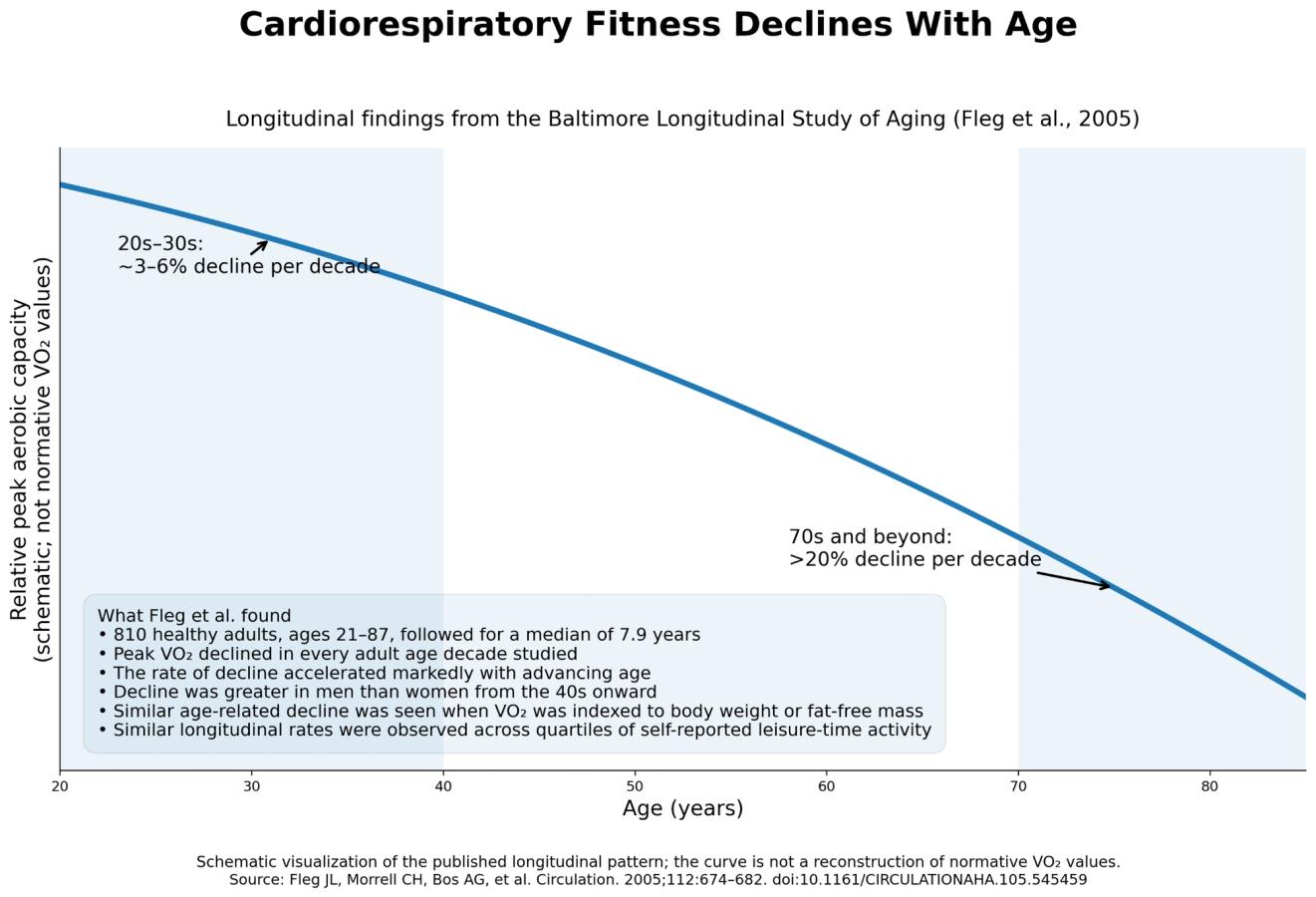
An important nuance is that these are population-level observations, not predictions of what will happen to a particular individual. People enter each decade with very different levels of fitness. Genetics, disease, body composition, training history, medications, injury, and changes in physical activity all influence an individual's trajectory. But the accelerating decline identified by Fleg et al. has an important practical implication: the amount of aerobic capacity you carry into later life matters.
Fitness determines how hard life feels
Every physical task requires some amount of energy. Walking across level ground requires relatively little. Walking quickly requires more. Add an incline, stairs, a suitcase, groceries, or a backpack, and the requirement increases further. Consider a hypothetical activity requiring an oxygen consumption of 15 mL/kg/min. For someone with a VO₂max of 45 mL/kg/min, that task represents about 33% of maximum capacity. For someone with a VO₂max of 30, it represents 50%. For someone with a VO₂max of 20, the same task requires 75% of maximum capacity. The task has not changed. The reserve has.
This is one reason declining fitness can eventually become noticeable in ordinary life. The physiological change may occur gradually over years, but at some point routine activities begin consuming a sufficiently large percentage of available capacity that they feel meaningfully harder. Stairs become something to avoid. Walking uphill requires a pause. Keeping pace with other people becomes difficult. Travel becomes more physically demanding. The environment has not necessarily become more challenging. The margin between the demands of the environment and maximum capacity has become smaller.
Eventually, aerobic capacity becomes a question of independence
There is no single VO₂max below which someone suddenly loses independence. Human function is much more complicated than that. Strength, power, balance, cognition, body weight, musculoskeletal health, disease, and the physical environment all matter. Nevertheless, studies in older adults demonstrate an important relationship between aerobic capacity and functional limitation.
In 161 community-dwelling adults ages 65–90, peak VO₂ was the measured variable most strongly associated with self-reported physical function. A VO₂peak of approximately 18.3 mL/kg/min best differentiated higher from lower physical function, although the investigators specifically found that there was not a sharp threshold effect.⁵ A separate study involving 192 adults ages 65–97 identified a VO₂peak around 20 mL/kg/min as a threshold associated with functional performance and reported functional limitations.⁶
These values should not be interpreted as universal clinical cutoffs. Someone with a VO₂max of 19 is not destined to become dependent, and someone at 21 is not protected. Instead, they illustrate the concept of reserve. As maximal capacity approaches the metabolic requirements of ordinary life, everyday tasks consume an increasingly large percentage of what the individual can produce.
Independence is an important goal—but it is a low bar
Preserving the ability to walk, shop, cook, bathe, dress, and live independently is enormously important. But most people want more from later life than simply remaining above the threshold of disability. They want to travel, hike, golf, ski, ride a bicycle, play tennis or pickleball, explore a new city on foot, carry their children or grandchildren, and work in the yard. And perhaps tolerate an illness, injury, or operation without losing months of function.
This changes the question. Rather than asking: “How much fitness do I need to remain independent?” A more useful question may be: “How much reserve do I want to have based on what I want to do?” A higher aerobic capacity gives ordinary activities more room below the ceiling. The objective is not simply to preserve enough fitness to remain independent. It is to preserve enough reserve to continue doing the things that make independence valuable.
Cardiorespiratory fitness is trainable
Age and genetics influences aerobic capacity but training can alter trajectory.
Structured aerobic training can produce meaningful improvements in VO₂max across adulthood, and these adaptations do not necessarily require years to develop. Measurable improvements can occur within several weeks, with many structured training studies demonstrating meaningful changes over approximately 6–12 weeks. Longer interventions with sufficient training intensity and volume generally produce larger improvements.⁷
A 2015 systematic review and meta-analysis of controlled trials in healthy adults found that both continuous endurance training and high-intensity interval training improved VO₂max, with average improvements of approximately 4.9 and 5.5 mL/kg/min, respectively, compared with non-exercising controls. High-intensity interval training produced a modestly greater improvement on average.⁷
Importantly, older adults remain trainable. A 2021 meta-analysis of 14 studies involving 429 middle-aged and older adults found average VO₂max improvements of approximately 2.3 mL/kg/min with interval training and 1.3 mL/kg/min with moderate-intensity continuous training. Interval training produced an approximately 1.1 mL/kg/min greater improvement on average.⁸
Those averages should not be interpreted as limits. The magnitude and rate of improvement vary considerably with baseline fitness, age, genetics, training volume and intensity, program duration, adherence, and health status.
The broader point is more important: VO₂max is not simply something you inherit and then watch decline. It is a trainable physiological characteristic and meaningful changes can occur over a period measured in weeks rather than years.
How do you improve it?
There is no single exercise intensity that is optimal for every purpose.
Lower- and moderate-intensity aerobic exercise allows substantial training volume to accumulate with manageable fatigue. Over time, this supports adaptations within skeletal muscle and mitochondria, increases capillary density, improves peripheral oxygen extraction and utilization, and improves the capacity to sustain prolonged work.
Higher-intensity exercise provides a stronger challenge near the upper limits of the oxygen-delivery and utilization system and can be particularly effective for increasing VO₂max.⁷˒⁸
The two approaches are complementary rather than competing. For most people, a durable aerobic program includes regular lower-intensity volume, appropriately dosed higher-intensity training, progression over time, and sufficient recovery to repeat the process consistently. More intensity is not automatically better.
The objective is to provide enough physiological stress to stimulate adaptation without creating so much fatigue, injury risk, or psychological burden that the program cannot be sustained. Consistency ultimately determines whether the adaptation accumulates.
VO₂max is important—but it is not the entire story
Two people can have the same VO₂max and experience exercise very differently. One may be able to sustain a relatively high percentage of that maximum for prolonged periods, while another begins experiencing increasing metabolic and ventilatory stress at a much lower workload. This is why measurements such as VT1 (aerobic threshold) and VT2 (anaerobic threshold) can add useful context.
Ventilatory thresholds (VT) help identify transitions in exercise intensity and provide information about how much of maximal capacity is actually usable during sustained activity.
Training can therefore improve performance and functional capacity even when the change in VO₂max itself is relatively modest. A person may be able to walk or run faster at the same heart rate, climb a hill with less ventilatory stress, exercise longer before fatigue, recover more quickly, or perform the same activity while using a smaller percentage of maximal capacity.
Those changes matter. The purpose of measuring fitness is not simply to generate a VO₂max score. It is to understand how the system performs.
Measure. Train. Reassess.
A VO₂max result is not a grade. It is a measurement of current capacity. The rest of the CPET provides context about how that capacity is being produced and where limitations may exist.
That gives us a process: Measure → Interpret → Train → Reassess
Establish the baseline. Determine what appears to be limiting performance. Build a training strategy around the individual's physiology, health, goals, and available time. Then measure again.
Did VO₂max improve? Did VT1 or VT2 move higher? Can the same workload now be performed at a lower physiological cost? Has recovery improved? Has body weight or body composition changed in a way that affects interpretation? Most importantly: Can the person do more? That is ultimately what fitness is for.
The goal is reserve
We cannot prevent aging. We cannot guarantee that illness, injury, or periods of inactivity will never reduce physical capacity. But we can influence how much capacity we have when those challenges arrive. A person entering older age with substantial aerobic reserve has more capacity available to lose before ordinary life approaches their physiological ceiling. That is why cardiorespiratory fitness is relevant long before someone becomes old or functionally limited.
Cardiorespiratory fitness can be measured. It can be trained. And it can be followed over time. The goal is not simply a higher VO₂max. It is to build enough capacity today (and preserve enough of it over time) that the physical demands of life remain comfortably below the limits of what your body can do.
Because ultimately, fitness is not about what happens during an exercise test. It is about what that capacity allows you to do outside of it.
References
- Ross R, Blair SN, Arena R, et al. Importance of assessing cardiorespiratory fitness in clinical practice: a case for fitness as a clinical vital sign. Circulation. 2016;134:e653–e699.
- Laukkanen JA, Isiozor NM, Kunutsor SK. Objectively assessed cardiorespiratory fitness and all-cause mortality risk: an updated meta-analysis of 37 cohort studies involving 2,258,029 participants. Mayo Clin Proc.2022;97:1054–1073.
- Lang JJ, Prince SA, Merucci K, et al. Cardiorespiratory fitness is a strong and consistent predictor of morbidity and mortality among adults: an overview of meta-analyses representing over 20.9 million observations from 199 unique cohort studies. Br J Sports Med. 2024;58:556–566.
- Fleg JL, Morrell CH, Bos AG, et al. Accelerated longitudinal decline of aerobic capacity in healthy older adults. Circulation. 2005;112:674–682.
- Morey MC, Pieper CF, Cornoni-Huntley J. Is there a threshold between peak oxygen uptake and self-reported physical functioning in older adults? Med Sci Sports Exerc. 1998;30:1223–1229.
- Cress ME, Meyer M. Maximal voluntary and functional performance levels needed for independence in adults aged 65 to 97 years. Phys Ther. 2003;83:37–48.
- Milanović Z, Sporiš G, Weston M. Effectiveness of high-intensity interval training and continuous endurance training for VO₂max improvements: a systematic review and meta-analysis of controlled trials. Sports Med.2015;45:1469–1481.
- Poon ETC, Wongpipit W, Ho RST, Wong SHS. Interval training versus moderate-intensity continuous training for cardiorespiratory fitness improvements in middle-aged and older adults: a systematic review and meta-analysis. J Sports Sci. 2021;39:1996–2005.
This article is for educational purposes only and does not constitute medical advice or the formation of a physician-patient relationship.