
Cardiometabolic Health
Understanding and Changing Your Health Trajectory

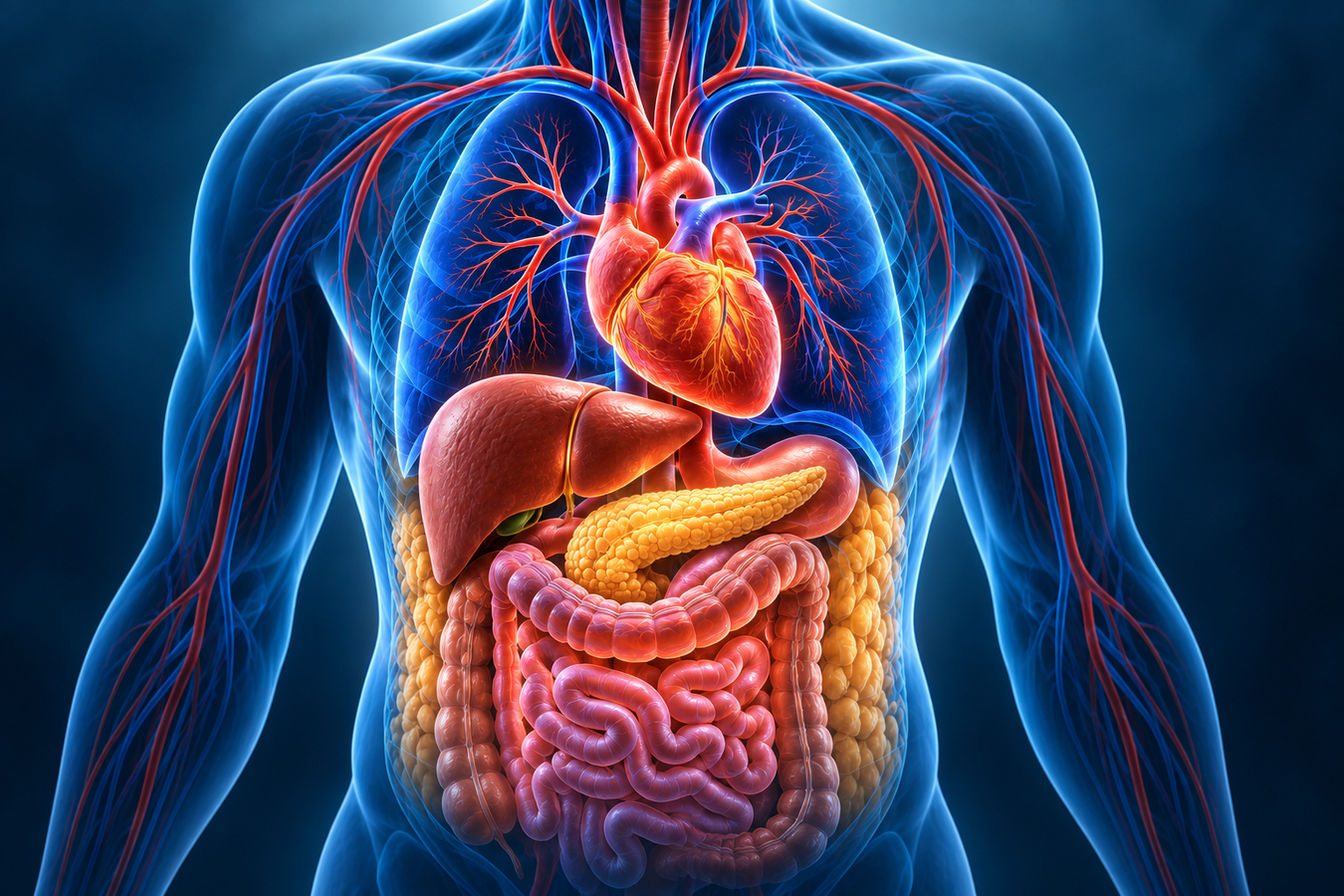
Cardiometabolic Health: Understanding and Changing Your Health Trajectory
Cardiovascular and metabolic health are often discussed as separate topics. In practice, they are deeply interconnected.
Blood pressure, atherogenic lipoproteins, glucose regulation, insulin sensitivity, body composition, physical activity, cardiorespiratory fitness, nutrition, sleep, smoking, medications, and genetics all interact over decades. Together, they influence the development of atherosclerotic cardiovascular disease, type 2 diabetes, stroke, heart failure, kidney disease, peripheral arterial disease, and other conditions that can affect both lifespan and quality of life.
It is important to recognize that while these conditions are diagnosed when conventional diagnostic thresholds are crossed, they develop along a continuum. Changes are occurring well before symptoms arise or a formal diagnosis is made. That creates an opportunity to identify unfavorable changes early, understand what is driving them, and intervene while there is still substantial opportunity to change the trajectory.
The problem: optimal cardiometabolic health is uncommon
Most people understandably think of themselves as healthy when they feel well and have not been diagnosed with a major disease. Unfortunately, the absence of symptoms is not the same thing as optimal cardiometabolic health.
A large analysis of 55,081 U.S. adults participating in the National Health and Nutrition Examination Survey evaluated cardiometabolic health using five domains: adiposity, blood glucose, blood lipids, blood pressure, and the absence of clinical cardiovascular disease. In 2017–2018, only 6.8% of American adults (fewer than 1 in 14 people) met optimal criteria across all five domains. That was down from 7.7% in 1999–2000, with some of the largest declines occurring in adiposity and glucose health.1
The clinical consequences are substantial. Cardiovascular disease remains the leading cause of death in the United States. In 2023, it accounted for 915,973 deaths, including heart disease, stroke, hypertension, and heart failure.2
But mortality is only part of the story. A heart attack that does not kill you still matters. So does a stroke that affects speech or mobility, peripheral arterial disease that limits walking, heart failure that makes climbing stairs difficult, diabetes requiring multiple medications, or progressive kidney disease.
For most people, the more meaningful goal is therefore not simply to avoid dying from cardiovascular disease. It is to preserve energy, physical capacity, cognitive function, independence, and quality of life for as much of life as possible.
Disease does not begin at the diagnostic threshold
Modern medicine needs thresholds. We need criteria for diagnosing hypertension, diabetes, hyperlipidemia, and other conditions. These thresholds are useful for research, communication, and treatment decisions. However, biology does not operate in categories.
Atherosclerosis does not begin when someone has a heart attack. Type 2 diabetes does not suddenly appear on the day hemoglobin A1c reaches 6.5%. A blood pressure of 129 mmHg does not represent fundamentally different vascular biology from 131 mmHg.
Instead, cardiometabolic disease generally develops gradually.

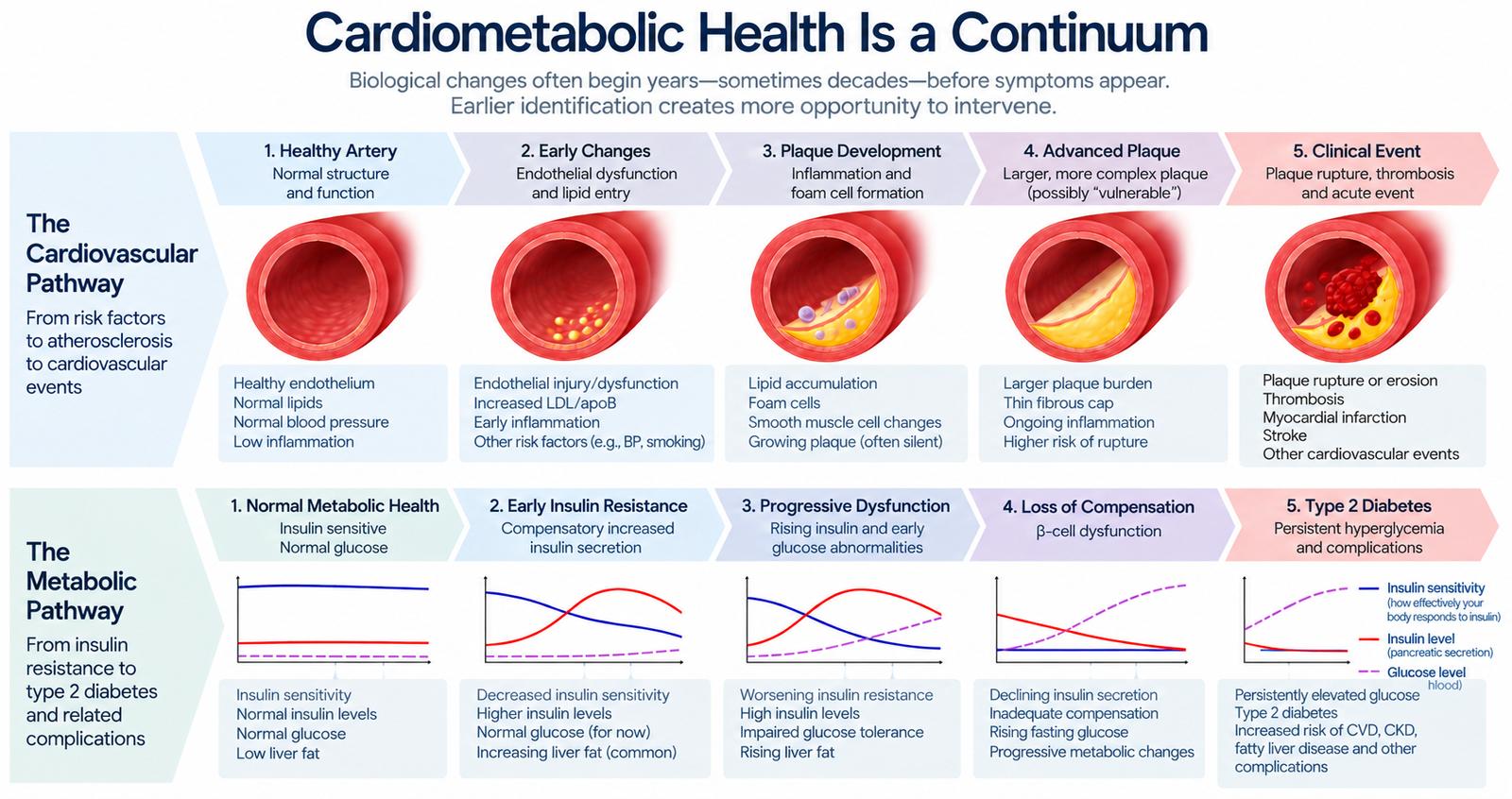
The cardiovascular pathway in the illustration reflects the established biology of atherosclerosis. ApoB-containing lipoproteins enter and become retained within the arterial wall, interacting with endothelial dysfunction and inflammatory processes. Fatty streaks and foam cells develop, plaques enlarge and remodel, and some plaques ultimately become susceptible to rupture or erosion, thrombosis, and acute cardiovascular events.3 What appears clinically as a sudden event may therefore represent the final stage of a biological process that has been progressing silently for years or decades.
Metabolic disease follows a similar principle. As insulin sensitivity declines, the pancreas can initially compensate by secreting more insulin. Blood glucose may remain normal during this period, sometimes creating the appearance that metabolism is normal even though substantially more insulin is required to maintain that glucose level. As insulin resistance progresses and pancreatic β-cell compensation becomes inadequate, glucose begins to rise and eventually reaches the diagnostic range for type 2 diabetes. The source model underlying this concept, developed in the context of NAFLD, describes increasing insulin secretion and reduced hepatic insulin clearance as compensatory responses before β-cell dysfunction and hyperglycemia become dominant.
This is why the question “Do I have diabetes?” is different from the question “How healthy is my glucose regulation?”
The same principle applies across cardiometabolic health. The objective is not simply to diagnose disease earlier. It is to understand where someone currently sits along a biological continuum, whether that position is stable, improving, or moving in the wrong direction.
Your trajectory is not predetermined
Genetics matters. Family history and inherited variation can substantially influence susceptibility to coronary disease, abnormal lipid metabolism, diabetes, obesity, hypertension, and other cardiometabolic conditions.
But genetic risk and modifiable risk are not competing explanations. In a study of more than 55,000 people, individuals with high genetic risk for coronary disease who followed a favorable lifestyle had a 46% lower relative risk of coronary events than individuals with similarly high genetic risk who had an unfavorable lifestyle. In one cohort, standardized 10-year event rates differed from 10.7% to 5.1% between those groups.5
That does not mean lifestyle “erases” genetics. It means inherited susceptibility exists within an environment that influences whether disease develops and how quickly it progresses.
For patients, the useful question is therefore not: “How much of my health is genetic?” but rather “Given the risk I inherited, what can we identify and meaningfully change?”
Cardiometabolic risk can change—sometimes substantially
Risk factors are not simply numbers associated with disease. Changing them can change outcomes.
In an individual-participant meta-analysis of randomized trials involving more than 340,000 people, each 5 mmHg reduction in systolic blood pressure was associated with approximately a 10% relative reduction in major cardiovascular events.6 Across 26 randomized lipid-lowering trials involving approximately 170,000 participants, each 1 mmol/L, or approximately 39 mg/dL, reduction in LDL cholesterol was associated with about a 22% relative reduction in major vascular events.7
The same principle applies to metabolic disease. In the DiRECT trial, intensive weight management produced remission of type 2 diabetes in a meaningful proportion of participants. During extended follow-up, 13% of participants continuing in the intervention were in remission at five years, and 26% of those who had been in remission at year two remained in remission at year five. The durability of remission was strongly related to maintaining weight loss.8
That is an important finding because it makes two points at once. First, at least some cardiometabolic disease is biologically reversible to a clinically meaningful degree. Second, maintenance matters. The physiology remains responsive to the environment, both positively and negatively.
Relative risk is not the same as individual benefit
Treatment-effect statistics can easily be misunderstood. A 20% relative reduction in risk sounds substantial, and sometimes it is. But its importance depends heavily on the risk you started with. If an intervention reduces relative risk by 20% and your baseline risk is 20%, your absolute risk falls to approximately 16%, an absolute reduction of 4 percentage points. If your baseline risk is 2%, the same 20% relative reduction lowers it to about 1.6%, an absolute reduction of 0.4 percentage points. The biological efficacy of the intervention may be similar, but the value of treatment to the individual is very different.
This is one reason cardiometabolic care should not simply consist of treating isolated laboratory values. Age, blood pressure, smoking, diabetes, kidney disease, family history, lipoproteins, body composition, fitness, established plaque burden, and other information change baseline risk. So do treatment burden, potential adverse effects, cost, and personal preferences.
The goal is not merely to ask whether an intervention works. It is to ask how much it is likely to matter for this person.
Changing the environment changes the physiology
The word lifestyle can make these interventions sound softer or less biological than medication. That is misleading. A more useful way to think about nutrition, exercise, physical activity, sleep, recovery, smoking, alcohol, and daily routines is as repeated physiological inputs.
Your body continuously responds to the environment you create for it. Food provides energy and nutrients and influences satiety, lipid metabolism, glycemic regulation, blood pressure, body composition, and the intestinal environment. Aerobic exercise challenges the systems responsible for transporting and utilizing oxygen. Resistance training provides a signal to maintain or increase muscle, strength, and glucose-disposing capacity. Sleep affects autonomic, endocrine, cognitive, metabolic, and recovery processes.
Physical inactivity is also a physiological signal. So are chronic excess energy intake, tobacco exposure, inadequate recovery, and sustained sleep restriction.
Over days, the immediate effects may be small. Over years, repeated exposures become biological trajectories. This is also where the difference between an outcome and a process becomes important. Wanting to lose 20 pounds, lower your blood pressure, improve glucose regulation, or avoid a future heart attack can provide direction. But those outcomes do not tell you what to do on Tuesday morning. It is the grocery decisions, workouts, sleep schedule, medications, meals, recovery, and thousands of repeated choices that create the physiological environment in which adaptation occurs. And sometimes the behaviors that were sufficient at age 30 are no longer sufficient at age 50. Aging changes body composition, vascular function, insulin sensitivity, aerobic capacity, recovery, and other aspects of physiology. Maintaining the same habits does not guarantee maintaining the same health.
Medication is not failure
The opposite mistake is assuming that because behavior matters, having to take medication represents failure. It does not. For appropriately selected patients, medications can substantially reduce cardiovascular and metabolic risk.
Blood-pressure-lowering therapy reduces major cardiovascular events. LDL-lowering therapy reduces myocardial infarction, ischemic stroke, and revascularization. Modern treatments for diabetes, obesity, heart failure, and kidney disease can produce clinically important benefits in appropriately selected patients.
Lifestyle and pharmacology are not competing philosophies. Sometimes improving nutrition, exercise, sleep, and body composition is sufficient. Sometimes inherited susceptibility or established disease makes medication worthwhile even when someone is doing nearly everything else well. And sometimes the most effective approach is both.
The relevant questions are: How large is the risk? How strong is the evidence? How much benefit is reasonably expected? What are the harms, burdens, and costs? Does the intervention align with the individual's priorities? The objective is not to take as few medications as possible nor is it to medicate every imperfect number. The objective is to use the appropriate tool for the appropriate problem.
Supplements should remain supplements
There is no shortage of products promising to improve metabolism, cardiovascular health, energy, or longevity. Some supplements have clear indications. Others have modest but legitimate evidence. Many have little meaningful clinical evidence at all.
But the name itself provides perspective. Supplements are intended to supplement a foundation. They cannot reproduce the adaptations produced by aerobic exercise. They cannot substitute for adequate muscle mass, appropriate energy balance, healthy blood pressure, tobacco avoidance, sufficient sleep, or an evidence-based dietary pattern.
This does not mean supplements have no role. It means their expected benefit should be considered in proportion to the major drivers of risk. A supplement producing a small change in a biomarker should not distract from a substantially elevated blood pressure, high apoB burden, untreated sleep apnea, smoking, low fitness, or worsening visceral adiposity.
The same principle applies to testing. More data is not inherently better. The purpose of measurement is not to build the largest possible dashboard. It is to identify information that changes what we understand, prioritize, or do.
Measure. Interpret. Prioritize. Act. Reassess.
Treat health like the valuable asset it is. Most people would not build a 30-year financial strategy by checking their bank balance once, choosing a few investments, and never reviewing them again. Health deserves a similarly long time horizon.
First, establish where you are. Then interpret in context. Next, prioritize. Not everything needs to be optimized simultaneously and some findings carry much greater risk than others. Some interventions have stronger evidence. Some changes improve multiple systems at once.
Then act and implement the process. The focus and energy is in executing the process consistently. Periodically reassess. Is the process creating the desired outcomes? If yes, maintain. If no, adjust and adapt.
This creates a repeating process: Measure → Interpret → Prioritize → Act → Reassess
The purpose of measurement is not measurement itself. It is better decision-making.
There is rarely a finish line
Meaningful physiological change takes time. Blood pressure may improve within days or weeks. Fitness can improve noticeably over weeks to months. Changes in body composition typically take months. Atherosclerotic risk accumulates over years and decades. Durable behavioral change may take longer still.
That can be frustrating in a culture built around short-term transformations. But cardiometabolic health is not a six-week project. When are you finished exercising, eating well, sleeping adequately, or maintaining your blood pressure? In many ways, that is like asking when you can stop brushing your teeth or wearing a seatbelt. The goal is not to complete a health program. It is to develop a way of living that you can continue.
The goal is a better trajectory
Cardiometabolic health is not binary. You are not simply healthy until the day you receive a diagnosis. Blood pressure changes. Atherogenic lipoprotein exposure accumulates. Insulin sensitivity can improve or deteriorate. Body composition changes. Fitness rises or falls. Behaviors change. The more useful questions are therefore not limited to: “Are my numbers normal?” They are: Where am I now? Where am I headed? Which factors are most likely to influence that trajectory? Which of those factors can meaningfully be changed? And which changes are worth making?
The purpose of understanding cardiometabolic health is not to eliminate every future uncertainty or pursue perfect physiology. It is to identify meaningful risk before it becomes a consequence, understand what matters most, and make better decisions about where to invest time, effort, and medical treatment.
Because prevention is ultimately not about predicting the future with certainty. It is about improving the probability of arriving there with more health, capability, and independence.
References
- O'Hearn M, Lauren BN, Wong JB, Kim DD, Mozaffarian D. Trends and disparities in cardiometabolic health among U.S. adults, 1999–2018. J Am Coll Cardiol. 2022;80(2):138–151.
- American Heart Association. Heart Disease and Stroke Statistics—2026 Update. U.S. cardiovascular mortality data for 2023.
- Nayor M, Brown KJ, Vasan RS. The molecular basis of predicting atherosclerotic cardiovascular disease risk. Circ Res. 2021;128:287–303. The review characterizes ASCVD as progressing through initiation, progression and complications, with apoB-containing lipoprotein deposition, inflammation and endothelial dysfunction central to early atherogenesis.
- Gastaldelli A, Cusi K. From NASH to diabetes and from diabetes to NASH: mechanisms and treatment options. JHEP Rep. 2019;1:312–328. The review describes progressive insulin resistance, compensatory insulin secretion, declining hepatic insulin clearance and eventual β-cell failure in the evolution toward type 2 diabetes in the setting of NAFLD.
- Khera AV, Emdin CA, Drake I, et al. Genetic risk, adherence to a healthy lifestyle, and coronary disease. N Engl J Med. 2016;375:2349–2358.
- Blood Pressure Lowering Treatment Trialists' Collaboration. Pharmacological blood pressure lowering for primary and secondary prevention of cardiovascular disease across different levels of blood pressure: an individual participant-level data meta-analysis. Lancet. 2021;397:1625–1636.
- Cholesterol Treatment Trialists' Collaboration. Efficacy and safety of more intensive lowering of LDL cholesterol: a meta-analysis of data from 170,000 participants in 26 randomised trials. Lancet. 2010;376:1670–1681.
- Lean MEJ, Leslie WS, Barnes AC, et al. 5-year follow-up of the randomised Diabetes Remission Clinical Trial (DiRECT) of continued support for weight loss maintenance in the UK: an extension study. Lancet Diabetes Endocrinol. 2024;12:233–246.