
Body Composition
What the Scale Doesn't Tell You

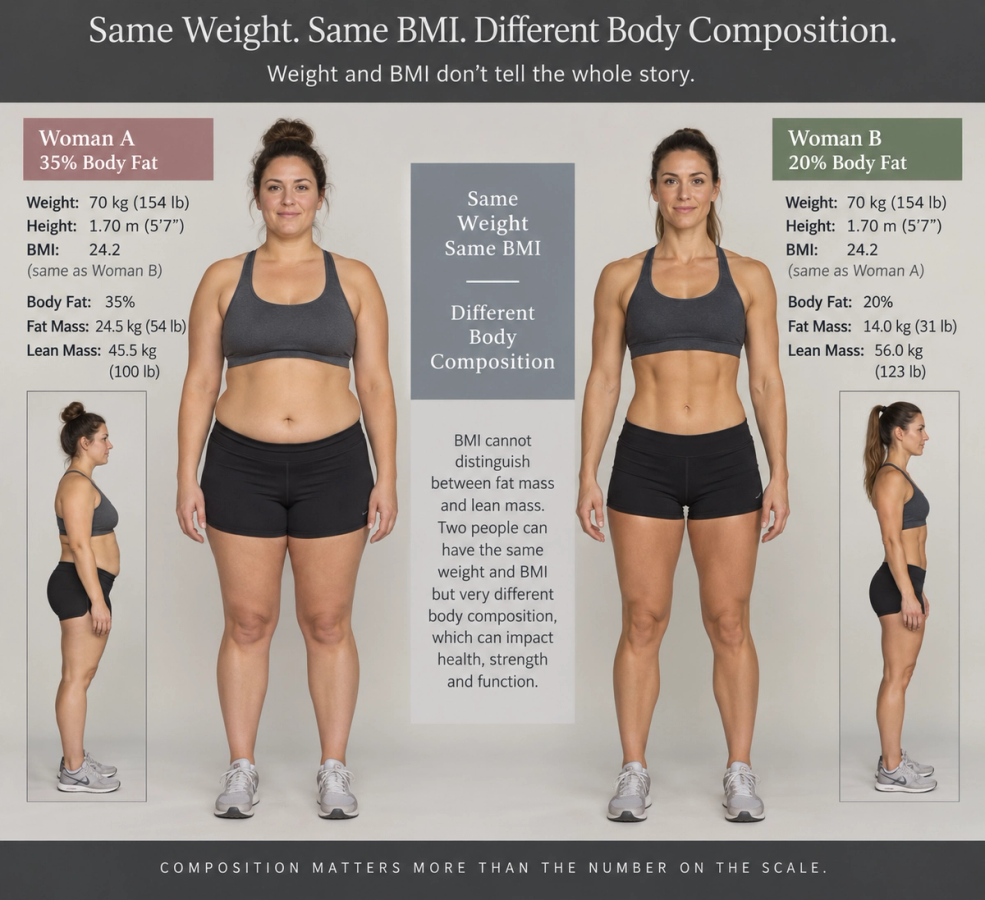
Body Composition: What the Scale Doesn't Tell You
Body weight is one of the simplest measurements in medicine. It is inexpensive, reproducible, and useful. It is also incomplete. A scale tells us how heavy you are. It cannot tell us how much of that weight is muscle or fat, where fat is stored, whether you are gaining or losing muscle, or whether a change in weight represents an improvement in health.
Two people can therefore have the same height, weight, and body mass index (BMI) while having remarkably different bodies, metabolic health, physical capacity, and long-term health trajectories. This becomes particularly important when trying to lose weight. The objective should rarely be simply to make the number on the scale smaller. A better objective is to reduce excess adipose tissue, particularly visceral fat, while preserving or building the muscle needed for metabolic health, strength, performance, and independence. That is the difference between focusing on weight loss and focusing on body composition.
Obesity is common—but BMI tells only part of the story
Obesity has become one of the most prevalent chronic health conditions in the United States. According to the most recent National Health and Nutrition Examination Survey data, 40.3% of U.S. adults have obesity and another 31.7% are overweight. Together, roughly 72% of American adults fall into one of these categories. Among adults ages 40–59 (the age range in which many people first begin noticing significant changes in metabolic health and physical capacity), the prevalence of obesity is approximately 46% (1,2).
These statistics are based on BMI because BMI is simple and useful for studying large populations. But even the CDC emphasizes an important limitation: BMI does not directly measure body fat and provides no information about where fat is distributed (2).
The image below shows two people who are each 5'10" and weigh 175 pounds. Their BMI is identical, and at 25.1, would technically be classified as “overweight”. But one carries considerably more adipose tissue and substantially less muscle, while the other has more muscle and less fat.

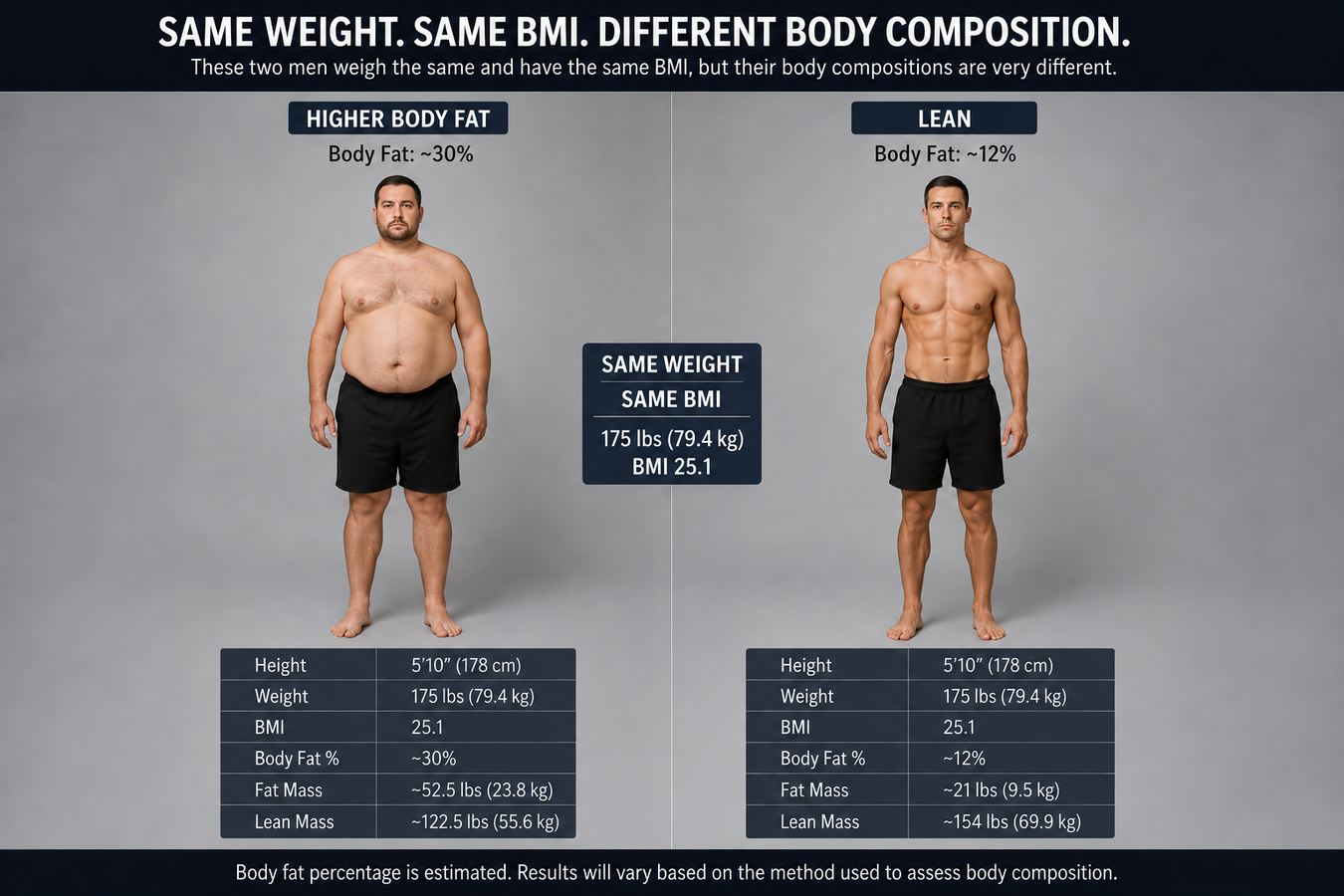
Weight and BMI cannot distinguish between them. That does not make BMI useless. It makes it a screening measurement rather than a complete description of someone's physiology.
Fat and muscle are biologically different tissues
A kilogram of muscle and a kilogram of fat contribute equally to the number on a scale. Physiologically, they are very different.
Skeletal muscle is not merely something that makes us stronger. It is a major site of glucose disposal and energy metabolism. It provides the machinery required to generate force, move through the environment, exercise, recover from illness and injury, and maintain physical independence.
Adipose tissue is also more than passive energy storage. Fat cells participate in endocrine and immune signaling, releasing hormones and signaling molecules (adipokines) that influence appetite, insulin sensitivity, vascular function, inflammation, and energy metabolism. Adipose tissue should therefore be understood as a metabolically active organ.
Not all adipose tissue behaves the same way. Subcutaneous fat stored beneath the skin and visceral adipose tissue stored within the abdominal cavity have different biological characteristics. Excess visceral adiposity is particularly associated with insulin resistance, type 2 diabetes, fatty liver disease, dyslipidemia, and cardiovascular disease (3,4).
As visceral adipose tissue expands and becomes dysfunctional, adipocytes can enlarge, become hypoxic and undergo cell death. The surrounding tissue develops greater immune-cell infiltration, inflammation, and fibrosis. Increased fatty-acid flux and inflammatory signaling into the portal circulation directly affect the liver, contributing to hepatic fat accumulation, insulin resistance and broader metabolic dysfunction (3).
This is one reason where you store fat can matter in addition to how much fat you carry. It also explains why measuring body composition and abdominal adiposity can add information that body weight alone cannot provide.
The other side of body composition: muscle
Most discussions of obesity focus almost exclusively on excess fat. That misses half of the problem. Beginning in adulthood, maintaining skeletal muscle becomes increasingly important. Aging, physical inactivity, illness, inadequate protein intake, hormonal changes and periods of weight loss can all contribute to declining muscle mass and function.
The combination of excess adiposity and impaired muscle mass/function is referred to as sarcopenic obesity. The European Society for Clinical Nutrition and Metabolism and the European Association for the Study of Obesity define sarcopenic obesity as the coexistence of excess adiposity with low skeletal-muscle mass and impaired muscle function. Their diagnostic framework emphasizes both altered body composition and functional impairment rather than simply identifying someone who has obesity and a low calculated muscle mass (5).
Estimates vary considerably because studies have historically used different definitions, but a meta-analysis of 50 studies estimated that sarcopenic obesity affects approximately 11% of older adults worldwide, with estimates reaching 19% in North American populations. A more recent analysis of community-dwelling adults 65 and older estimated prevalence at approximately 14% (6,7).
The combination matters. Compared with robust older adults, those with sarcopenic obesity had approximately 3.8 times the odds of frailty in a recent meta-analysis. Another large systematic review found a 51% higher relative risk of all-cause mortality compared with healthy individuals, along with associations with cardiovascular disease, metabolic disorders, functional limitation and cognitive impairment (8,9).
This creates an important distinction: Someone can have too much fat and too little functional muscle at the same time. The scale, and sometimes BMI, can obscure that problem.
Weight loss and fat loss are not the same thing
When someone says they want to lose weight, what they usually mean is that they want to lose fat. The body does not necessarily cooperate with that distinction. During caloric restriction, body weight can be lost from adipose tissue, lean tissue, glycogen, water and other compartments. Some loss of lean tissue commonly accompanies significant weight loss.
That means a successful weight-loss program needs to accomplish two related but distinct goals: create enough energy deficit to reduce adipose tissue while providing enough stimulus and nutritional support to preserve muscle.
This is where the evidence becomes remarkably practical.
First: an energy deficit drives weight loss
Despite considerable debate over individual diets, sustained loss of body mass requires energy intake to be lower than energy expenditure over time. That does not mean all diets are metabolically identical or equally easy to follow. Food quality, protein, fiber, energy density, palatability and dietary structure influence hunger, satiety, nutritional adequacy, metabolic health and adherence.
But there is no dietary strategy that bypasses energy balance. The best calorie deficit is therefore not necessarily the largest one. It is one that produces meaningful fat loss while remaining nutritionally adequate and sustainable enough to continue.
Second: protein matters
During weight loss, adequate dietary protein tends to improve satiety, provides amino acids needed to maintain and repair skeletal muscle and supports the muscle-protein synthetic response to training. Protein needs depend on age, body size, training status, kidney function, magnitude of energy restriction and other individual factors. There is therefore no single appropriate protein prescription for everyone.
The broader principle is more important: If the objective is fat loss rather than indiscriminate weight loss, adequate protein should be intentional rather than incidental. But protein alone is not enough.
Resistance training is not optional if preserving muscle is the goal
This is probably the most important practical distinction between a weight-loss program and a body-composition program.
During caloric restriction, skeletal muscle needs a reason to remain and resistance training provides that signal. A 2025 systematic review and meta-analysis of 25 randomized trials compared dietary weight loss alone with dietary weight loss plus resistance exercise in adults with overweight or obesity. Adding resistance training did not meaningfully change total body-weight loss, but it reduced the loss of fat-free mass, increased fat-mass loss, and improved strength (10).
That is an important finding. If you judge success only by the scale, resistance training may appear to add little. If you measure what was actually lost, the difference becomes much more meaningful.
A larger meta-analysis encompassing 114 trials and more than 4,000 participants reached a similar conclusion. Resistance training combined with caloric restriction produced substantial reductions in body-fat percentage and fat mass while largely maintaining lean mass. Resistance training without caloric restriction increased lean mass by approximately 0.8 kg on average (11).
Aerobic exercise remains extremely valuable. It improves cardiorespiratory fitness, cardiovascular health, metabolic function and energy expenditure, and it can reduce visceral fat (10,16). But aerobic exercise and resistance training are not interchangeable.
If someone is intentionally losing significant weight, resistance training should be considered a core component of the treatment, not an optional addition.
Measure what you are actually trying to change
No single body-composition measurement is perfect.
That is another reason not to become overly attached to any individual number.
Waist circumference is simple, inexpensive and surprisingly useful. Because abdominal circumference reflects central adiposity, changes in waist circumference can provide information about fat distribution that weight and BMI cannot.
Waist-to-height ratio adds body size to that interpretation. Across 78 studies in a systematic review, waist-to-height ratio and waist circumference predicted diabetes and cardiovascular outcomes at least as well as—and often better than—BMI. A waist-to-height ratio around 0.5 emerged as a useful population-level boundary, giving rise to the simple heuristic of keeping your waist circumference below roughly half your height (12).
Dual-energy X-ray absorptiometry (DXA) provides estimates of total and regional fat mass, lean mass and bone mineral content. It can also provide information about regional adiposity and appendicular lean mass, making it considerably more informative than weight or BMI when a detailed baseline is useful (13).
Bioelectrical impedance analysis (BIA) is faster, inexpensive, noninvasive and particularly useful for repeated measurements. However, it estimates body composition indirectly and is affected by hydration, food intake, exercise and the predictive algorithms used by the device. DXA and BIA therefore should not be treated as interchangeable measurements (14,15).
For longitudinal monitoring, consistency matters. Measuring under similar conditions, with the same device and methodology, often matters more than arguing over small differences between methods. And the most useful question is usually not: “What is my exact body-fat percentage?” It is: “Is my fat mass decreasing while my muscle is being preserved or increased?”
That is the change we are actually trying to produce.
What about GLP-1–based medications?
Modern anti-obesity medications, including GLP-1–based therapies such as semaglutide and dual GIP/GLP-1 therapies such as tirzepatide, have fundamentally changed the treatment of obesity.
For appropriately selected patients, these medications can produce substantial weight loss and meaningful improvements in cardiometabolic risk. They do not, however, change the underlying objective. The goal is still not simply to make someone lighter.
As body weight decreases, some lean tissue is typically lost along with fat. The magnitude and significance of that loss varies with the individual, the amount and rate of weight loss, age, nutrition, physical activity and how lean mass is measured.
For this reason, significant pharmacologic weight loss should still be accompanied by attention to adequate protein intake, resistance training, nutritional adequacy and longitudinal assessment of body composition and function. Medication can be an extraordinarily useful tool. It does not eliminate the need to preserve the tissue you want to keep.
Faster is not necessarily better
Rapid changes on the scale can be psychologically rewarding. Physiologically, however, the objective is not to lose the greatest amount of weight in the shortest possible time.
More aggressive energy restriction increases the challenge of consuming adequate protein, micronutrients and total nutrition and can increase the amount of lean tissue lost.
Small randomized data comparing similar amounts of weight loss achieved at different rates found that slower weight loss produced greater reductions in fat mass and body-fat percentage, while rapid loss produced greater reductions in lean and fat-free mass (17).
The takeaway principle is that the rate of weight loss should be subordinate to the quality and sustainability of the weight loss. For most people, the objective is not to arrive at the lowest possible weight quickly. It is to arrive at a healthier body composition and be able to maintain it.
Nutrition becomes more important during weight loss
Eating fewer calories means eating less food. That makes the nutritional quality of the food you do eat increasingly important.
Protein must remain adequate. Essential fatty acids still matter. Fiber matters. Vitamins and minerals still matter. Fruits, vegetables, legumes, whole grains, nuts, seeds and other nutrient-dense foods have to compete for space within a smaller energy budget.
The more aggressive the calorie restriction (or appetite suppression from medication) the easier it can become to consume too little protein, fiber or essential micronutrients simply because total food intake has fallen. This is one reason for intentional nutrition and appropriate monitoring during substantial weight loss.
The goal is not simply a smaller body
There is an understandable temptation to define success by a target weight. But imagine losing 30 pounds while becoming weaker, losing substantial muscle, developing nutritional deficiencies and abandoning the behaviors that produced the weight loss as soon as the target is reached.
The scale may say the intervention worked. Physiologically, the result is much less convincing.
A better objective is to reduce excess adiposity (particularly visceral adiposity) while preserving or increasing muscle, maintaining strength, improving metabolic health and creating a nutritional and exercise pattern that can actually be sustained.
A sustainable calorie deficit. Adequate protein. Intentional, nutrient-dense nutrition. Resistance training throughout the process. Aerobic exercise and regular physical activity. Periodic reassessment of body composition, waist measurements, strength and metabolic health.
And time. Body composition changes gradually. Muscle takes time to build. Excess adipose tissue accumulated over years does not need to disappear in weeks.
The objective is not to finish a diet. It is to create a body and a set of behaviors that better supports metabolic health, physical performance, resilience and the activities you want to continue doing throughout your life.
The scale can be useful for tracking that process. It just should not be confused with the goal.
References
- Fryar CD, Afful J, Saif NT. Prevalence of Overweight, Obesity, and Severe Obesity Among Adults Age 20 and Older: United States, 1960–1962 Through August 2021–August 2023. National Center for Health Statistics; 2026.
- Emmerich SD, Fryar CD, Stierman B, Ogden CL. Obesity and Severe Obesity Prevalence in Adults: United States, August 2021–August 2023. NCHS Data Brief. 2024;508.
- Lee MJ. The pathophysiology of visceral adipose tissues in cardiometabolic diseases. Biochem Pharmacol.2024;222:116116.
- Khanna S, et al. Role of systemic and epicardial adipose tissue in cardiometabolic disease. Nat Rev Cardiol. 2026
- Donini LM, Busetto L, Bischoff SC, et al. Definition and diagnostic criteria for sarcopenic obesity: ESPEN and EASO consensus statement. Clin Nutr. 2022;41:990–1000.
- Gao Q, Mei F, Shang Y, et al. Global prevalence of sarcopenic obesity in older adults: a systematic review and meta-analysis. Clin Nutr. 2021;40:4633–4641.
- Luo Y, et al. Prevalence of sarcopenic obesity in the older non-hospitalized population: a systematic review and meta-analysis. BMC Geriatr. 2024; (24(1):357
- Gengxin Y, et al. Association between sarcopenic obesity and risk of frailty in older adults: a systematic review and meta-analysis. Age Ageing. 2025; 54(1).
- Liu C, et al. Deciphering the “obesity paradox” in the elderly: A systematic review and meta-analysis of sarcopenic obesity. Obes Rev. 2023; 24(2)
- Binmahfoz A, Dighriri A, Gray C, Gray SR. Effect of resistance exercise on body composition, muscle strength and cardiometabolic health during dietary weight loss in people living with overweight or obesity: a systematic review and meta-analysis. BMJ Open Sport Exerc Med. 2025;11:e002363.
- Lopez P, et al. Resistance training effectiveness on body composition and body weight outcomes in individuals with overweight and obesity across the lifespan: a systematic review and meta-analysis. Obes Rev. 2022.
- Browning LM, Hsieh SD, Ashwell M. A systematic review of waist-to-height ratio as a screening tool for cardiovascular disease and diabetes. Nutr Res Rev. 2010;23:247–269.
- Bazzocchi A, Ponti F, Albisinni U, et al. DXA: technical aspects and application. Eur J Radiol. 2016.
- Teigan LM, et al. The Use of Technology for Estimating Body Composition: Strengths and Weaknesses of Common Modalities in a Clinical Setting. Nutr Clin Pract. 2017; 32(1):20-29.
- Marra M, Sammarco R, De Lorenzo A, et al. Assessment of body composition in health and disease using BIA and DXA: a critical overview. 2019.
- Bellicha A, van Baak MA, Battista F, et al. Effect of exercise training on weight loss, body composition changes, and weight maintenance in adults with overweight or obesity. Obes Rev. 2021.
- Ashtary-Larky D, et al. Rapid Weight Loss vs. Slow Weight Loss: Which is More Effective on Body Composition and Metabolic Risk Factors? Int J Endocrinol Metab. 2017; 15(3).
This article is for educational purposes only and does not constitute medical advice or the formation of a physician-patient relationship.